
News
Mindanao Reels from Strongest Earthquake Since 1976 Moro Gulf

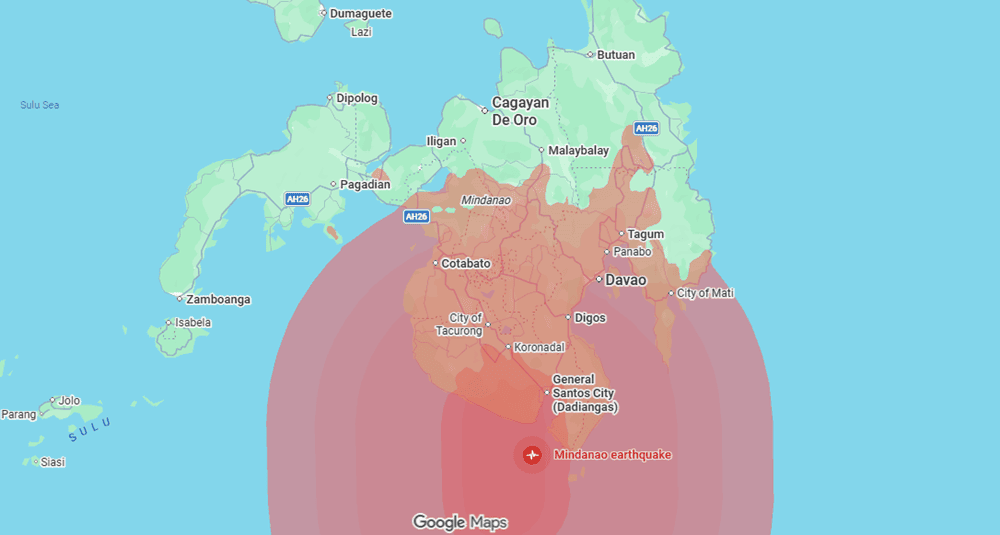
A powerful 7.8-magnitude earthquake struck off the coast of Mindanao on Monday morning, killing at least 37 people and injuring hundreds as rescue teams continued searching for survivors across the southern Philippines.
Officials said the quake hit about 7:37 a.m. local time at a depth of roughly 35 kilometers, with its epicenter near Maasim town in Sarangani province. It was the strongest temblor to strike the country since the 1976 Moro Gulf quake.
Devastation in Mindanao
The Office of Civil Defense reported 37 confirmed deaths Tuesday, with 33 in Region 12 and four in Region 11. Most fatalities were caused by falling debris, collapsed buildings, and landslides, civil defense spokesperson Junie Castillo said. At least 456 people were injured in Region 12 alone, and four people remained missing. More than 17,000 families were affected across the area.
A landslide in the mountain town of Glan, Sarangani province, buried several homes and killed 13 residents, provincial disaster official Rene Punzalan said. General Santos City reported seven deaths after several small buildings, including a restaurant, collapsed.
Tsunami warnings, aftershocks
The quake prompted tsunami alerts for the Philippines and neighboring countries. Local measurements recorded waves up to 4.6 feet in Kiamba town, with 3-foot waves washing ashore in parts of Sultan Kudarat and Sarangani. Smaller tsunami readings were reported in Indonesia and Palau.
Warnings were broadly lifted within hours after the Pacific Tsunami Warning Center said the immediate risk had diminished. Authorities recorded more than 200 aftershocks, the strongest measuring magnitude 6.7.
Government action and international aid
President Ferdinand Marcos Jr. ordered immediate mobilization of government agencies to assist evacuations and rescue efforts. The Department of Social Welfare and Development prepared more than 1.1 million food packs for distribution in affected communities. Classes across Mindanao were suspended while officials urged residents to stay alert for aftershocks.
Several countries, including France, China, Israel, Japan, and the United States, offered international assistance and support
What residents face now
Search-and-rescue teams continue clearing rubble and reaching remote communities cut off by landslides. Authorities are assessing damage to roads, homes, and critical infrastructure and prioritizing the delivery of food, water, and medical aid to displaced families.
If you are in an affected area, follow local advisories, avoid damaged buildings, and keep emergency supplies ready. Family members outside the region should expect communication delays as authorities focus on response and recovery.