Enterprise
Training Deficit Puts Philippines’ AI Cybersecurity Push at Risk

Philippine firms are deploying AI-powered cybersecurity tools at near-universal rates, but a new industry report warns that workforce training and talent development have failed to keep pace, leaving enterprises exposed to breaches that cost millions and take months to resolve.
The 2026 Global Cybersecurity Skills Gap Report, released this week by cybersecurity firm Fortinet, found that while 94% of IT and security decision-makers in the Philippines are already using or piloting AI-driven security solutions, 73% cite the shortage of AI-skilled cybersecurity talent as their top recruitment challenge. The survey, which polled 60 leaders across the technology, manufacturing, and financial services sectors, points to a structural mismatch between the speed of technology adoption and the readiness of the human capital required to operate it.
The findings underscore a growing consensus among industry leaders that the next phase of cybersecurity resilience will depend less on software procurement and more on sustained investment in training, certification, and reskilling programs.
A Billion-Peso Problem With a Training-Shaped Hole
According to the report, 93% of Philippine organizations experienced at least one security breach in the past 12 months. More than half (52%) said a single breach cost them upward of US$1 million. 70% needed more than a month to recover.
And for the third straight year, IT leaders pointed to the same root cause: a lack of cybersecurity skills. 71% named it as a top driver of breaches.
Bambi Escalante, Fortinet’s Country Manager for the Philippines, framed the challenge bluntly in a statement accompanying the report. “Strengthening cyber resilience requires a long-term commitment to people, continuous learning, and building the capabilities needed to address today’s threats and tomorrow’s challenges,” she said, noting that developing talent with expertise in AI, automation, and governance has become “just as important as investing in new technologies.”
Yet the appetite for that investment remains uneven. 55% of respondents said they struggle to get internal approval to hire additional cybersecurity talent. 63% said senior-level skills are what they need most, the exact tier of expertise that is hardest to build quickly and hardest to poach from competitors.
The AI Governance Blind Spot
The report also flags a quieter but potentially more dangerous gap: the one between the C-suite’s confidence and its actual understanding of AI risk.
65% of Philippine leaders believe their Board members are “fully aware” of the risks posed by employee use of AI. But the report suggests that confidence may be misplaced. 78% of respondents expect a growing need for dedicated AI oversight and governance roles on cybersecurity teams within the next three years, an acknowledgment that the current leadership structure is not built for the AI era.
In other words, the people approving AI budgets may not fully grasp what those budgets are unleashing.
The Training Reckoning
The data shows a significant shift in attitude toward workforce development. 96% of respondents said they would prefer an employee to hold a cybersecurity certification, a sharp rise from 82% just one year ago. 98% said they are likely to invest in AI-related cybersecurity training or certifications within the next 12 months.
Organizations are also looking inward. 73% are building internal training and reskilling programs specifically to support AI adoption. 65% are turning to industry vendors to procure external training. The skillsets in highest demand are telling: AI model development (68%), security automation (61%), and AI tool oversight (56%), all disciplines that barely existed as mainstream cybersecurity requirements five years ago.
The pipeline problem is also being addressed at its source. 97% of surveyed organizations now use internships, apprenticeships, and partnerships to pull talent from underrepresented groups, while 88% have set formal hiring targets from underutilized talent pools.
One Million People, One Pledge
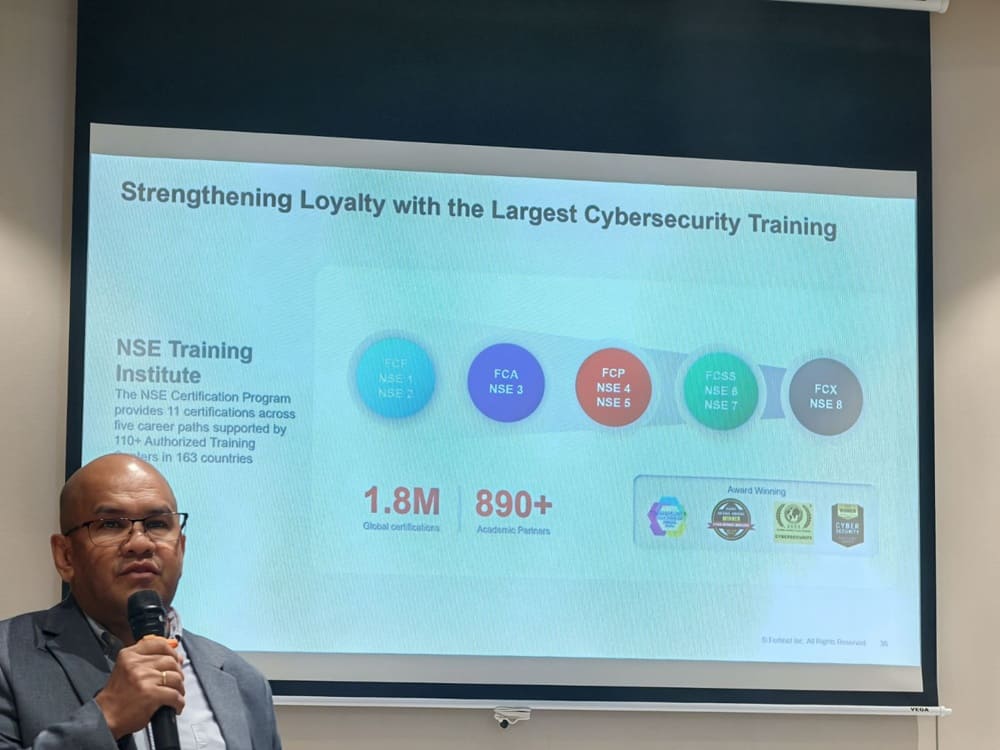
Fortinet itself is attempting to move the needle at scale. The company’s award-winning Fortinet Training Institute, which offers one of the industry’s broadest cybersecurity training programs, includes a Security Awareness Training service designed to build a cyber-literate workforce from the ground up.
More notably, Fortinet says it is on track to train one million people in cybersecurity globally this year, a commitment it first made in 2022.
The Road Ahead
The report’s closing argument is straightforward: technology alone cannot close a gap that is, at its core, a people problem. Fortinet urges Boards and executive teams to adopt a layered strategy built on three pillars: raising awareness and education, expanding access to targeted training and certification, and deploying advanced security technologies.
The Philippines has clearly checked the third box. AI-powered security tools are everywhere. What the Fortinet data makes clear is that the first two boxes, the ones about people, about classrooms, about the slow and unglamorous work of building human expertise, are where the real battle will be won or lost.